Explosives contamination blocking access to chemical weapons sites in Syria - HALO Trust

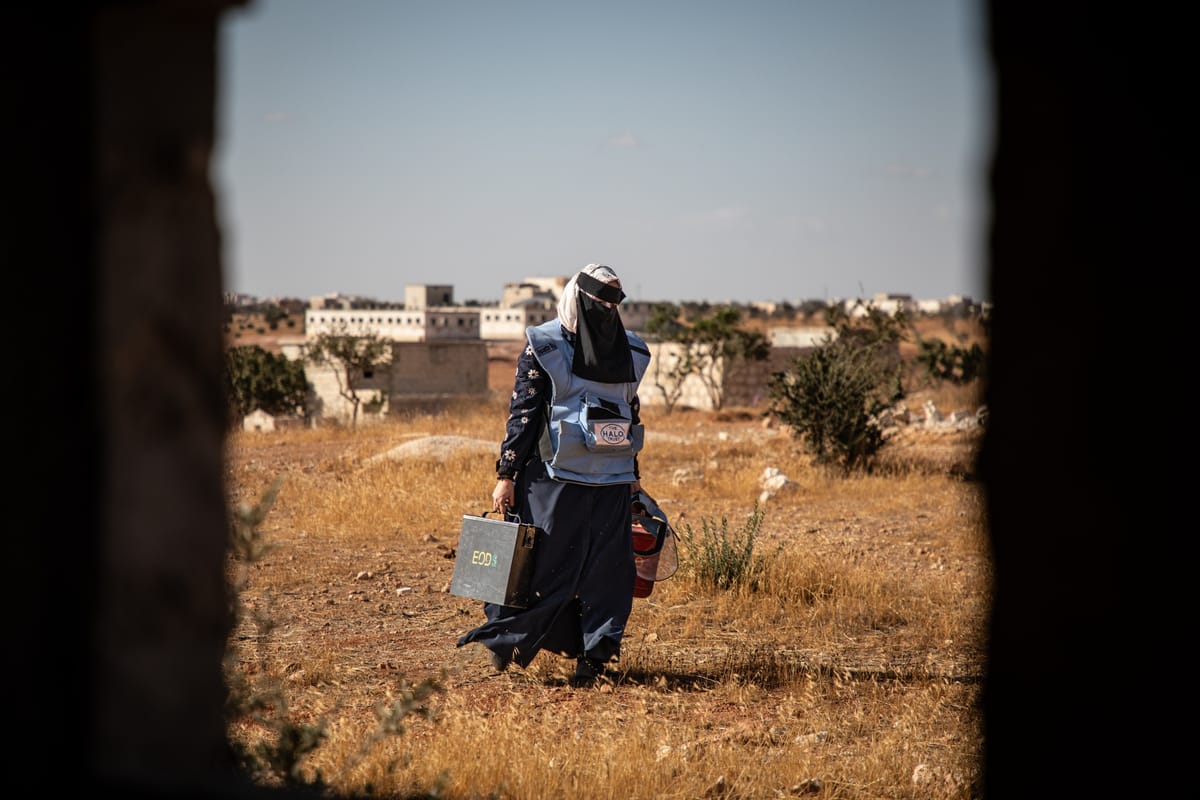
The HALO Trust has appealed to the international community to support the clearance of landmines, unexploded ordnance, IEDs and damage caused by aerial bombardment to enable the verification and dismantling of banned stockpiles of chemical weapons in Syria.
Briefing the UN Security Council in New York on Tuesday 10 March, Andrew Moore, HALO's regional director for the Middle East and North Africa, outlined how contamination from conventional weapons is severely blocking access for UN and Syrian government inspectors suspected chemical weapons sites.
"Clearance of landmines and unexploded ordnance is an essential first step to enable safe and secure inspections by the Organisation for the Prohibition of Chemical Weapons," said Moore.
"Many suspected chemical weapons sites heavily damaged by aerial bombardment may contain perimeter or internal minefields, unexploded air-dropped or guided munitions, booby traps or improvised explosive devices, many requiring armoured mechanical assets to remove them. The good news is that it is a practical problem that can be solved quickly and safely with the right expertise and funding."
"As well as reducing fatalities and injuries, international investment in explosives clearance supports desperately needed building and infrastructure reconstruction and contributes to Syria’s long-term recovery and stability.
"With enough funding this vital work can be delivered safely, effectively and to the highest international standards," Moore concluded.
Since January 2025, HALO has expanded its operations in Syria from 40 to 250 staff, 96 percent of whom are Syrian nationals. However, HALO needs around $9.5 million USD to sustain its current work in Syria this year alone, and Moore stressed that immediate donor funding is needed.
The HALO Trust and Syrian Civil War
Syria sees among the highest levels of accidents involving unexploded ordnance in the world, according to the Landmine Monitor 2025.
The HALO Trust currently has operations across seven governorates in Syria, including Idlib, Aleppo, Deir ez-Zor, Daara, Damascus and Homs, clearing rural areas of landmines and surveying explosive hazards in urban areas and providing risk education classes to families and children.
HALO is the world's largest humanitarian landmine clearance organisation, employs 9,000 staff worldwide and recruits 95 percent of them locally. It was founded in Afghanistan in 1988.
During the 13-year civil war in Syria from March 2011 to December 2024, the now deposed regime led by Bashar Al Assad was accused of the majority of chemical weapons attacks, prompting international condemnation and military responses.
The Ghouta attack in August 2013 - the deadliest use of chemical weapons in the conflict and the worst since the Iran–Iraq War - prompted an international agreement to eliminate Syria's chemical weapons and dismantle its arsenal. Although most declared stockpiles were destroyed, several lethal chemical attacks followed in subsequent years.