India says Nipah virus outbreak is contained as countries tighten health screening


Indian authorities have said that they have successfully contained an outbreak of the deadly Nipah virus after confirming two cases in the eastern state of West Bengal since December.
In a statement released on Tuesday 27 January, India’s Ministry of Health said that, upon confirmation of those two cases, the national government and the government of West Bengal "initiated prompt and comprehensive public health measures in accordance with established protocols".
196 contacts linked to the confirmed cases were identified, traced, monitored and tested, all of whom were asymptomatic and tested negative for Nipah.
"Enhanced surveillance, laboratory testing and field investigations were undertaken through coordinated efforts of Central and State health agencies, which ensured timely containment of the cases," the statement added, noting that no additional Nipah cases have been detected so far.
The statement also claimed that "speculative and incorrect figures regarding Nipah" had been circulated in "certain sections of the media", and advised "the public and media to rely only on verified information released by official sources and to refrain from spreading unverified or speculative reports".
Neighbouring countries increase testing
Despite there not being any cases reported outside India, the figures labelled as "speculative and incorrect" by the Indian government led neighbouring countries to increase precautionary health screening at airports.
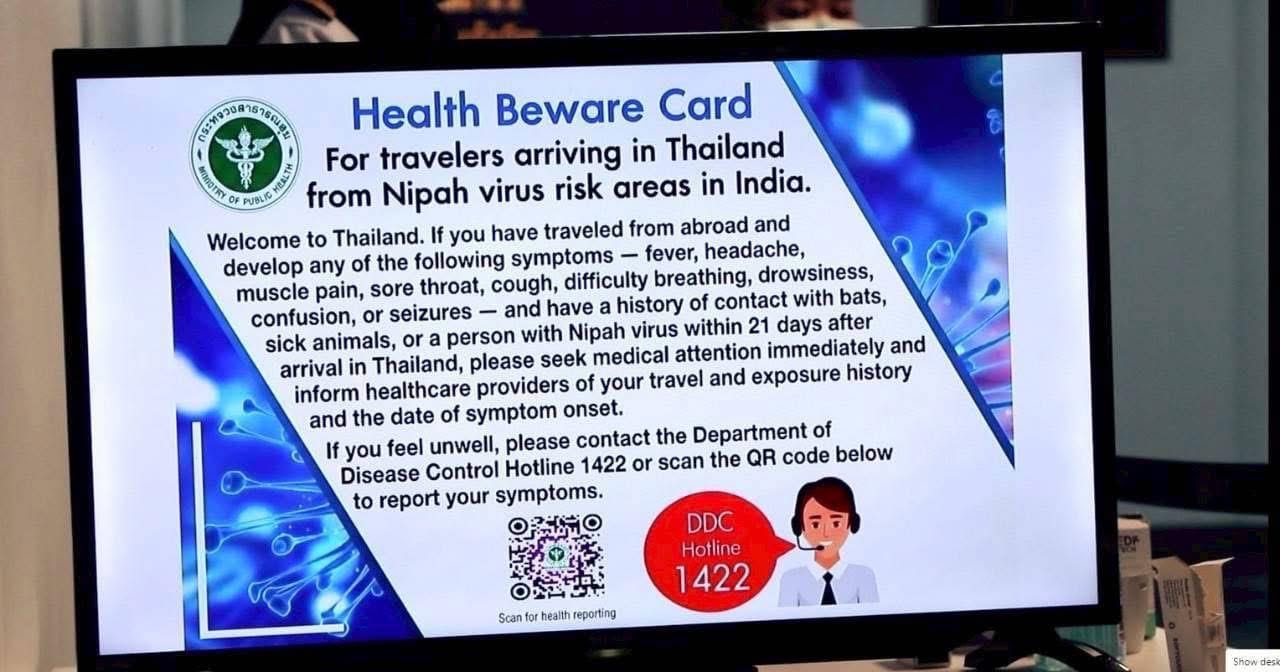
Indonesia and Thailand implemented health declarations, temperature checks and visual monitoring for arriving passengers at Bangkok’s Suvarnabhumi and Don Mueang airports. Nepal also started screening passengers arriving at Kathmandu Airport and at land borders.
Myanmar advised against non-essential travel to West Bengal and urged travellers to seek immediate medical care if symptoms develop within 14 days of travel. It said fever surveillance introduced during the COVID-19 pandemic at airports has been intensified for passengers arriving from India, with laboratory testing capacity and medical supplies readied.
China said it was strengthening disease prevention measures in border areas, with state media reporting that health authorities had begun risk assessments, enhanced training for medical staff, and increased monitoring and testing capabilities.
About the Nipah virus
The Nipah virus is zoonotic, meaning that it can be transmitted between animals such as pigs and fruit bats, to humans. It can also spread person-to-person through contaminated food.
The World Health Organization has listed Nipah among its top ten priority diseases along with COVID-19 and Zika, because of its potential to trigger an epidemic. The incubation period ranges from four to 14 days and it has a death range of between 45 to 70 percent due to the lack of any vaccine or medicine to treat it, making it considerably more deadly than COVID-19.
Initial symptoms may include fever, headaches, muscle pain, vomiting and a sore throat, however some people who do contract the virus may not exhibit any symptoms. Latter symptoms and complications include drowsiness, altered consciousness and pneumonia, with encephalitis - a sometimes-fatal condition that causes inflammation of the brain - sometimes occurring in severe cases.
Earlier Nipah outbreaks were reported in West Bengal in 2001 and 2007, while recent cases have largely been detected in India's southern Kerala state. A major outbreak in 2018 killed at least 17 people in Kerala.