New robot swabbing technology trialled for the first time at Sellafield, UK

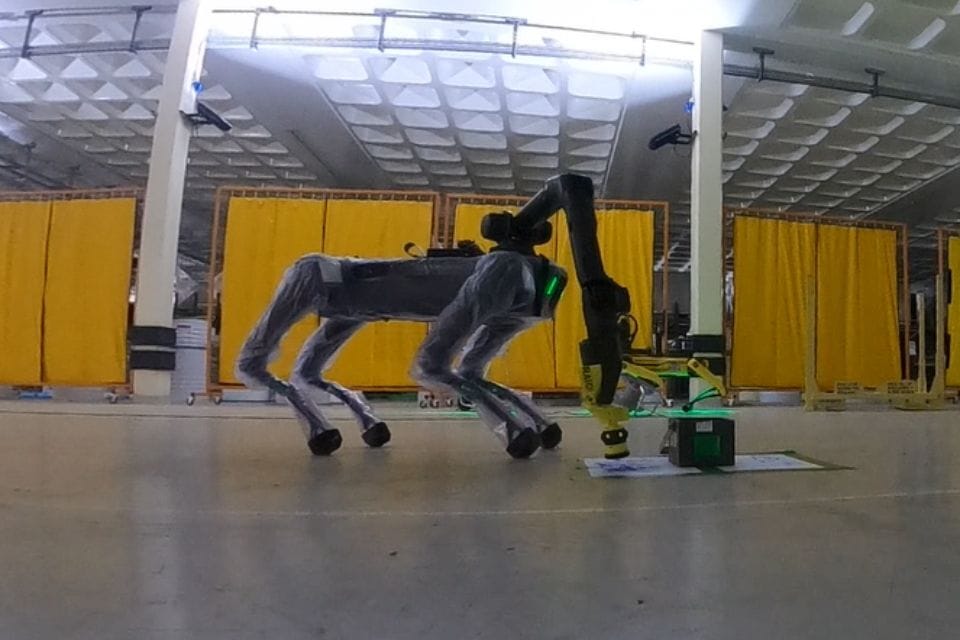
Sellafield Ltd and the Robotics & AI Collaboration (RAICo) have successfully completed the first trial of a specially designed robot dog swabbing tool, in an area containing radioactive material. The announcement was made by Sellafield Ltd and the UK government's Nuclear Decommissioning Authority.
Swabbing is a common task at Sellafield, a former nuclear power station that is currently being decommissioned and the site of the worst nuclear accident in British history in 1957.
Using circular paper filters, these swabs monitor radiation levels across a range of surfaces, providing vital data that informs decommissioning strategies and ensures compliance with safety regulations.
The swabbing tool was developed through RAICo, a collaboration between the UK Atomic Energy Authority, Sellafield Ltd, the Nuclear Decommissioning Authority and its wider nuclear estate, the University of Manchester and AWE Nuclear Security Technologies – as part of its mission to accelerate the deployment of robotics and AI for nuclear decommissioning and fusion engineering. The trial used Boston Dynamics' "Spot" robot designed by RAICo.
During the trial, "Spot" was sent into a restricted area to inspect a simulated radiological spill and take a physical swab from a mock-contaminated surface. The robot used the new tool to swab the surface and bring back a sample of blue chalk simulant.
"The robot completed the task successfully, showing that a process traditionally performed by humans could potentially be carried out remotely without compromising accuracy or safety," according to the UK government.
Sellafield's remote operated vehicle lead, Deon Bulman, said that the successful trial of the equipment "represents the significant opportunity we have to improve both safety and efficiency for nuclear decommissioning here at Sellafield".
"The quadruped’s agility and stability allow it to access areas that are hazardous for personnel, while intuitive haptic feedback provides precise, human-like manipulation, reducing task time and increasing confidence in the samples collected."