250kg World War II bomb safely disposed in Plymouth, England

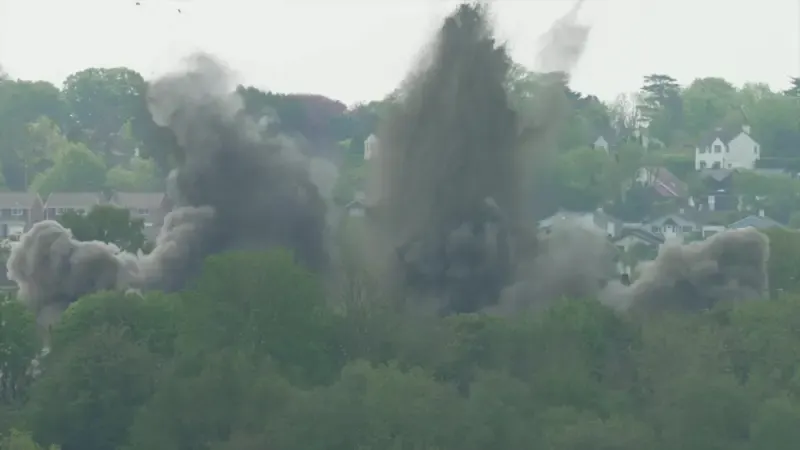
A World War II-era bomb weighing some 250kg has been safely disposed of in a controlled explosion in Plymouth, southwest England.
The bomb was discovered on a building site in the Southway area of the city on Wednesday afternoon, 29 April, and led to the two-day evacuation of around 1,200 homes.
According to the BBC, military bomb disposal experts advised Plymouth City Council to extend a cordon from 200m to 400m to allow its specialist teams to "continue their work safely".
In a briefing to the media on Thursday, 30 April, Colonel Nick Handy of the British Army's 8 Engineer Brigade revealed that they could not ascertain whether the fuse inside the bomb was a time fuse with a mechanical timer, or an electrical fuse with a capacitor that had been drained.
This uncertainty meant that it was not safe to move the bomb and they instead had to "blow it in situ".
Bomb disposal experts used specialist charges and intense heat to safely destroy the bomb and prevent a much larger explosion, according to Colonel Handy. Shaped charges carefully penetrated the bomb and reached the explosives inside to focus the blast in a specific direction, allowing it to cut through metal rather than exploding outwards in all directions.
Handy said the device burned at about 1,000C for about 10 minutes, with some of the explosives detonating during the process. Only about a third of the bomb’s 130kg explosives went off in a "high order" explosion, allowing the operation to be completed safely and residents to return home.
Colonel Handy warned that many more explosive devices could still be buried underneath towns and cities across southern England. Towards the end of WWII, German pilots often dropped their remaining bombs as soon as they reached Britain to try and return home as quickly as possible.
"As a result, the south coast is probably littered with bombs," he said. "Have we found them all? Absolutely not. Will we find more? Absolutely."